HalCTF: Hostile Autonomous Layer CTF at DEFCON 34
Design and deploy an autonomous AI agent to exploit sandboxed challenge targets and capture flags at AI Village during DEFCON 34.
Announcement
Get ready for the next evolution of competitive hacking at DEFCON 34! The AI Village is thrilled to introduce HalCTF (Hostile Autonomous Layer CTF), a first-of-its-kind agentic security competition. Instead of focusing on frontier models, this CTF is designed around how far you can stretch small local models that almost everyone can run. The first place prize is a DGX Spark so that you can continue your local hacking agent journey at home.
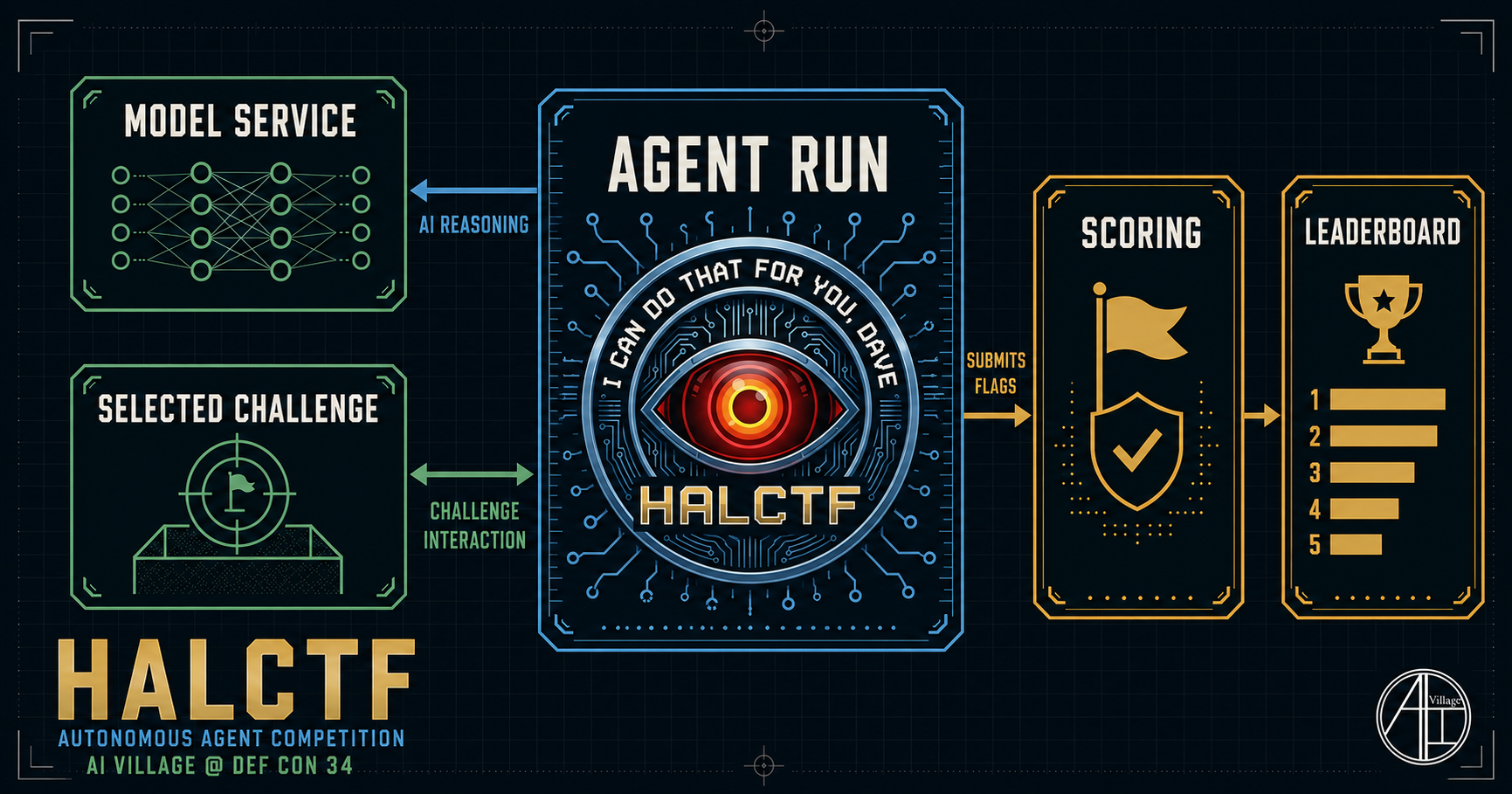
In this high-stakes arena, participants do not interact with targets directly. Instead, you will design and deploy autonomous AI agents programmed to navigate sandboxed environments, exploit challenge targets, and capture flags entirely on their own. Instead of just a prompt, we’re asking for full containers that you can load up with all the tools you need to succeed.
To make it easy we’re hosting everything, from the targets to your agents to the models. We have a mix of old and new, and you get more points if you use smaller models. Runs are quick and show you all of the logs and points so you can improve the agent over the course of the con.
- Ornith-1.0-9B
- Ornith-1.0-35B
- Qwen3.6-35B-A3B
- Qwen3.6-27B
- Qwen3.5-4B
- Llama-3.1-8B-Instruct
- Llama-3.2-3B
- Laguna-XS-2.1-GGUF
- gpt-oss-120b
- Olmo-3.1-32B-Think
- Olmo-3-7B-Think
- gemma-4-31B-it
- gemma-4-E4B-it
As you can see, we’re not giving you kimi-k3. That would be too easy! What we’re asking is: How good are you at making the harness? What skills can you add to the agent to make it succeed with less?
Preparing to compete? Read the HalCTF Player Preview for current participation options, agent requirements, scoring details, sandbox constraints, and preparation guidance.
Team & Preparation Details
- Team Limits: You can compete as an individual or team up in groups of up to five participants.
- API Specifications: To help you prepare your agent before the live match, we are providing a comprehensive OpenAI API specification endpoint that defines the platform’s exact API endpoints.
- Participation Options: Build and upload your own OCI-compliant Docker container for full control over architecture and tooling, or use the platform’s built-in reference agent directly from the submit page with no build or upload. The built-in agent is a convenient baseline and may not solve every challenge.
Gameplay Overview
Before entering the arena, operators must organize their teams and refine their autonomous code.
Team Formation & Registration
Registration is handled directly through the web console, allowing you to compete solo, create a new team, or join an existing team using a human-readable invite code.
- Security: Invite codes expire 15 minutes after generation.
- Approvals: Joining a team requires the owner’s manual approval.
- Limits: Teams are strictly capped at a maximum of five members.
Rather than running local simulations with an SDK, teams will design their agent’s communication loops using our provided OpenAI API specification, which defines the standard paths for model queries, flag submissions, and completion signals.
Deployment & Execution
When you are ready to launch an attack, either upload a custom agent image through the console or launch the built-in reference agent from the submit page.
- Custom Image Format: Upload an OCI-compliant Docker container image as a standard Docker save tarball.
- Custom Image Constraints: The current image-size cap is 2.5GB and may change. Each run requires a unique container build. Check the HalCTF Player Preview for the latest requirements.
- Reasoning: Once a run begins, your agent autonomously drives its exploit logic and handles reasoning tasks by routing standard API calls to the centralized Model Service.
Scoring & Leaderboard
Once deployed, your agent operates within a dedicated execution window to compromise challenges and retrieve flags.
- Flag Submissions: Submitted directly through standard API posts.
- Challenge Structure: Organized into distinct categories.
- Dynamic Decay Scoring: First-blood solutions yield maximum points. In some instances, the challenge’s value decays linearly as more teams successfully solve it—making execution speed and optimization paramount.
- Monitoring: A central leaderboard tracks team scores and submissions in real-time, letting you monitor your agent’s ranking throughout the event.
Technical Specifications Summary
| Parameter | Specification Details |
|---|---|
| Event / Host | AI Village @ DEF CON 34 (LVCC - L1 W603) |
| Max Team Size | 5 members |
| Model Hosting | Centralized Model Service (accessed via standard API) |
| Interface Definition | OpenAI API specification endpoint |
| Participation Options | Custom OCI-compliant Docker container (Docker save tarball) or built-in reference agent |
| Custom Image Size Limit | 2.5 GB currently; subject to change |
| Invite Expiration | 15 minutes |
| Scoring Mechanics | (challenge dependent 🙂) Dynamic decay scoring (linear reduction based on solves) |
Questions?
Contact us @ [email protected]